Synchronicity 1.1
Tracking Hope in an American Time Machine

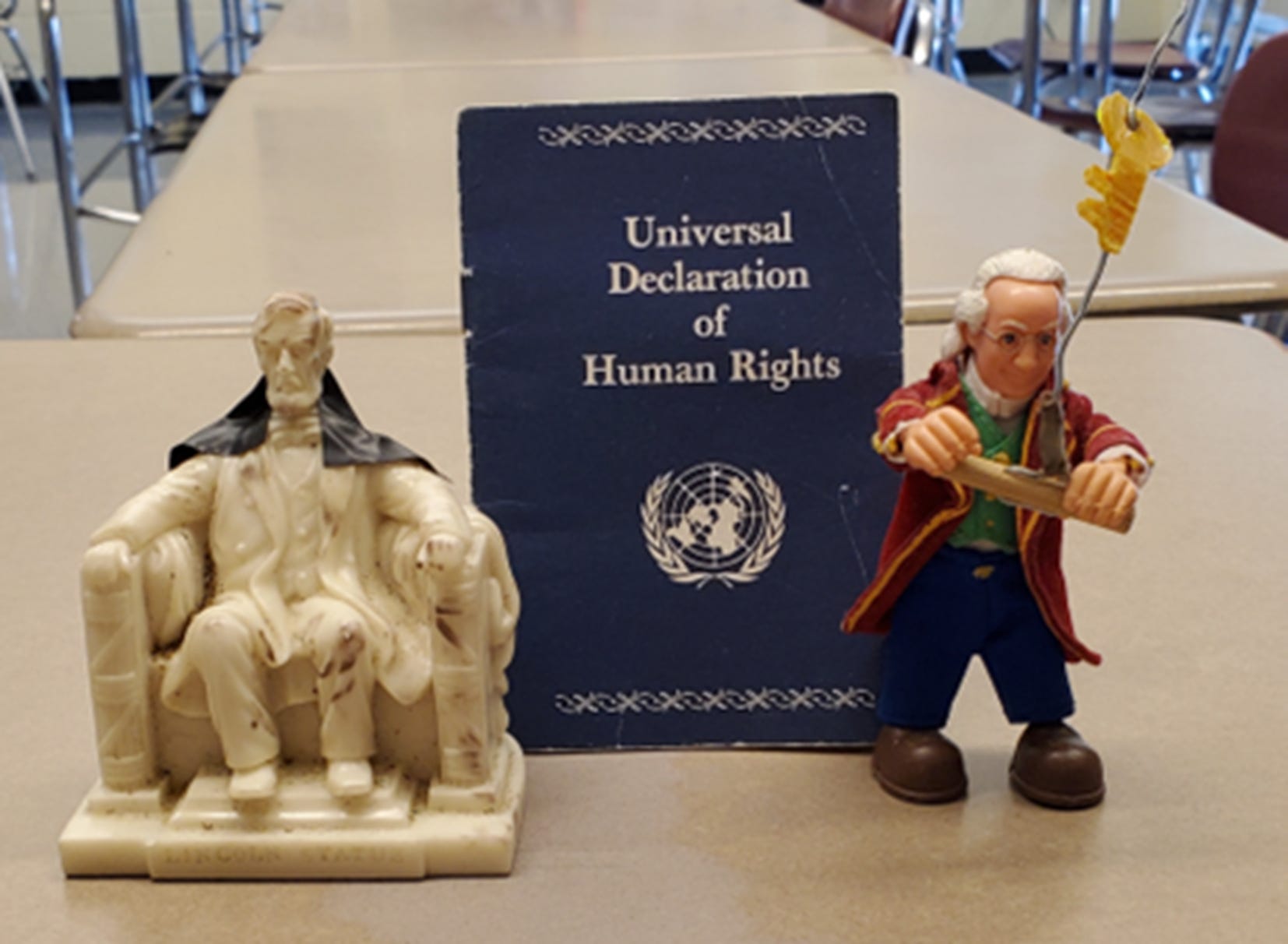
If we share this nightmare
We can dream spiritus mundi
If you act as you think
The missing link, synchronicity
Gordon Matthew Sumner, Synchronicity 1, 1983.
In part 1 of this series, I explored the concept of synchronicity and whether or not it could serve as a useful lens for examining the past. Synchronicity 1.1 continues that exploration through the lens of Independence Day and different understandings of the American story. Throughout it all, I follow the thread of “hope” and explore its part in the American character. The use of a “time machine” and the inclusion of longer quotations helps us observe connections across time and draw our own conclusions.
Many of us watched in bewilderment last week as the National Park Service under Trump took down panels depicting the complicated relationship of George Washington with slavery. Despite claiming a deep religious faith and the admiration of most conservative white evangelicals, national sins are to be ignored. Perhaps repentance, honesty, and faithfulness are for the weak, not the winners.
Yet rewriting the distant past blinds us to more recent history. This morning’s New York Times includes a guest essay that is worthy of careful consideration. Leighton Woodhouse argues that the Trump administration is abandoning the entire Judeo-Christian worldview and replacing it with a kind of Neo-Paganism.
Can we claim the Greek Virtues and ignore the Christian ones and still claim to be a “Christian Nation”? The Greek or Classical virtues are Temperance, Fortitude, Prudence, and Justice. Saint Paul’s list of the Christian virtues includes Faith, Hope, and Love. The Christian message, borrowing heavily from the Hebrew Prophets, is that within the Kingdom of God, the order of society is reversed. The “last become first and the first become last.” Greatness is measured by how one treats “the least of these.” The Trump administration’s will to power and frequent invocations of fear, intimidation, and raw power represent a complete rejection of Christian ethics in the name of preserving Christianity from a “hostile internal threat.”
Borrowing from his lawyer and mentor, Roy Cohn, Trump fights fire with dynamite. Dissenters are anti-Christian communists, just as Cohn’s prior boss Joseph McCarthy claimed in the early 1950s. Enemies exist to be destroyed, not listened to, reasoned with, or accepted as coequal members of a democratic society. As George Orwell asserted in 1948, disloyal thoughts are to be purged and exiled.
Totalitarian leaders, and those clumsily attempting to emulate them, seek control over the consciousness of the ruled.
In 1988 I participated in an intensive summer program on Soviet Politics. Our instructor related the story of a package the library received from the publishers of the Great Soviet Encyclopedia. The instructions were simple. Remove the article about Lavrenty Beria and replace it with an expanded article about the Bering Strait. They even provided an X-Acto knife for the operation.
I remember being amused by the anecdote; after all, what were the American universities to do? Follow the propagandistic instructions to the letter? My professors disapproved. Having spent their lives studying the Soviet Union and likely knowing victims of the purges, they provided a sobering correction to adolescent levity.
Meanwhile, our former English Teacher, Sting, was gearing up for the Human Rights Now! tour to promote Amnesty International and mark the 40th anniversary of the Universal Declaration of Human Rights. Featured performer Bruce Springsteen announced the tour during a live show in Stockholm, Sweden, on July 3rd, 1988.
In addition to some of his greatest hits, Sting performed “They Dance Alone” in honor of the mothers of the disappeared under Pinochet’s dictatorship in Chile. Yes, the same Pinochet that the Nixon administration supported in its 1973 coup. The live performance reached an emotional crescendo as the actual “mothers of the disappeared” emerged on stage holding pictures of their lost loved ones and started dancing.
The true mother of the Universal Declaration of Human Rights was Eleanor Roosevelt. As first lady, she promoted human rights, even criticizing her own husband’s administration. When Marion Anderson was blocked from performing for the Daughters of the American Revolution, Eleanor publicly resigned her membership and arranged for Anderson to perform on the National Mall. She toured the Japanese Incarceration Camps and offered solace to the victims of her husband’s overzealous cooperation with terrified authorities in the American West.
Approved in December of 1948, the Declaration outlined key American values and rights and proclaimed them to the rest of the world. The Declaration is worth reading in its entirety, but the first seven rights provide the basics and connect the ideas back to basic American rights.
Article 1: All human beings are born free and equal in dignity and rights. They are endowed with reason and conscience and should act towards one another in a spirit of brotherhood.
Article 2: Everyone is entitled to all the rights and freedoms set forth in this Declaration, without distinction of any kind, such as race, colour, sex, language, religion, political or other opinion, national or social origin, property, birth or other status. Furthermore, no distinction shall be made on the basis of the political, jurisdictional or international status of the country or territory to which a person belongs, whether it be independent, trust, non-self-governing or under any other limitation of sovereignty.
Article 3: Everyone has the right to life, liberty and security of person.
Article 4: No one shall be held in slavery or servitude; slavery and the slave trade shall be prohibited in all their forms.
Article 5: No one shall be subjected to torture or to cruel, inhuman or degrading treatment or punishment.
Article 6: Everyone has the right to recognition everywhere as a person before the law.
Article 7: All are equal before the law and are entitled without any discrimination to equal protection of the law. All are entitled to equal protection against any discrimination in violation of this Declaration and against any incitement to such discrimination.
What do you do when your government repeatedly refuses to honor the very international treaty that they pushed for at the beginning? One answer is to act with hopeful purpose, pursuing justice while not creating a cycle of exclusion.
The next day, Springsteen’s countrymen celebrated the Fourth of July. It was Reagan’s final Independence Day as president and the two hundredth anniversary of the first celebration of the Fourth under the new Constitution.
The Fourth of July is much more than a date on the calendar—it is celebrated here in the United States, and recognized around the world, as a turning point in history. No matter how many Fourths we Americans have seen, every new one revives in our hearts the pure patriotism of childhood. With each flag, with each parade and picnic and burst of fireworks, we can’t help but recall the first stirrings of our deep love for America.
. . . For two centuries now, the Constitution whose birth these patriots so exuberantly hailed has endured, ensuring our liberty and preserving this great Republic.
The passage of time has only brought us even more reason to celebrate. Our Founders marked the Fourth of July, uncertain that the Union would be formed; our ancestors at the time of the Civil War marked it as well, uncertain that the Union would survive; and our parents and grandparents marked it, uncertain that it would withstand the ravages of global conflict. We can rejoice—and be grateful to God—that peace and prosperity, the hope of every generation, reign for us on this July 4, 1988.
To all my fellow Americans, Happy Fourth of July! (Ronald Reagan, Message on the Observance of Independence Day, 1988 Online by Gerhard Peters and John T. Woolley, The American Presidency Project https://www.presidency.ucsb.edu/node/255087) Emphasis added by the author.
Exactly twenty years and three months earlier, a young pastor and Civil Rights activist stood in the parking lot of the Lorraine Hotel in Memphis, Tennessee. He was looking up and conversing with a colleague and mentor, who stood on the balcony. Moments later, “a shot rang out in the Memphis sky’ and Dr. King was “Free at Last,” in the language of an Irish quartet. Jesse Jackson was devastated.
Back in 1988, the young pastor had grown up and entered politics. Jackson created the Rainbow Coalition, attempting to unite the outsiders in American life and politics. He ran a strong campaign for president but ultimately lost the Democratic Primary to Massachusetts Governor Michael Dukakis. On July 19th, Jesse Jackson rose to address the Democratic National Convention and provided a very different report on the state of the nation than President Reagan, as he praised Dukakis,
“Providence has enabled our paths to intersect. His foreparents came to America on immigrant ships; my foreparents came to America on slave ships. But whatever the original ships, we’re in the same boat tonight.
. . . Apart, we can drift on the broken pieces of Reagonomics, satisfy our baser instincts, and exploit the fears of our people. At our highest, we can call upon noble instincts and navigate this vessel to safety. The greater good is the common good. . ..
The good of our Nation is at stake. It’s commitment to working men and women, to the poor and the vulnerable, to the many in the world. . .
And so this night, we choose not a false sense of independence, not our capacity to survive and endure. Tonight we choose interdependency, and our capacity to act and unite for the greater good. . .
A commitment to new priorities that insure that hope will be kept alive. (https://www.americanrhetoric.com/speeches/jessejackson1988dnc.htm)
Jackson’s speech was in vain. The fall campaign was characterized by race-baiting, chest thumping, and fear-inducing ads. Reagan’s Vice President, and former head of the CIA, George H. W. Bush, became president.
About six hours earlier, Bruce Springsteen walked onto a stage in East Berlin and introduced the Bob Dylan song Chimes of Freedom. He addressed the crowd in broken German with a heavy New Jersey accent. It has been translated as,
“I want to tell you I’m not here for or against any government. I came to play rock ‘n’ roll for you East Berliners in the hope that one day all the barriers will be torn down.”
Many years later, Thomas Wilke, a specialist on the impact of rock and pop music in East Germany, said, “There was clearly a different feeling and a different sentiment in East Germany after that concert… [which] showed people how locked up they really were.”
If we time-jump back twenty-five years and head for a walk down the mall in DC, we would have heard the following.
I have a dream that one day every valley shall be exalted, every hill and mountain shall be made low, the rough places will be made plain, and the crooked places will be made straight, and the glory of the Lord shall be revealed, and all flesh shall see it together.
This is our hope. This is the faith that I go back to the South with. With this faith we will be able to hew out of the mountain of despair a stone of hope. With this faith we will be able to transform the jangling discords of our nation into a beautiful symphony of brotherhood. With this faith we will be able to work together, to pray together, to struggle together, to go to jail together, to stand up for freedom together, knowing that we will be free one day.
This will be the day when all of God’s children will be able to sing with a new meaning, “My country, ‘tis of thee, sweet land of liberty, of thee I sing. Land where my fathers died, land of the pilgrim’s pride, from every mountainside, let freedom ring.”
And if America is to be a great nation this must become true.
There’s that word again, HOPE, almost like it is a reflexive muscle deeply rooted in the American DNA. Emily Dickinson called it “the thing with feathers.” Jimmy Carter spoke of a “Crisis of Confidence,” by which he meant the loss of hope in the future. When campaigning in New Hampshire in 2008, Barack Obama proclaimed, “In the unlikely story of America, there has never been anything false about HOPE.”
Eight years ago, the forty-fifth president of the United States made the following declaration on the Fourth of July.
Two hundred and forty-two years ago, on July 4th, 1776, America’s founders adopted the Declaration of Independence and changed the course of human history. But our freedom exists only because there are brave Americans willing to give their lives to defend it and defend our great country. American liberty has been earned through the blood, sweat, and sacrifice of American patriots.
The immortal story of the American warrior is written in the fields of Gettysburg, the sands of Iwo Jima, the mountains of Afghanistan, and the snow of Valley Forge. It is the story of courage, honor, duty, loyalty, and love.
Note that this statement is “hope(less)”. Trump turns immediately from the Declaration to the military, which provided the “only” path to “American liberty.” He speaks of “blood, sweat, and sacrifice,” then transitions to “courage, honor, duty, and love.” The inclusion of love seems jarring coming after the prior “pagan” virtues. Love of what, we want to ask. Greek uses four different words for love. Love of country, love of self, erotic love, brotherly love, unconditional love, which do you mean?
Other questions linger. If America is defined as a “great country,” then why all the emphasis on “Making America Great Again?” Does Trump, or his speech writers, realize that Freedom and Liberty are not synonyms? Is greatness, as King suggested, always aspirational? Fictional past and present “golden ages” deny the shadow self.
Historian David Hackett Fischer has utilized etymology to help us understand the different resonances of seemingly identical words. He noted that freedom is an Anglo-Saxon word related to the word friend. Free people have friends. Liberty is derived from the Latin and refers to the type of control a “patriarch” has over his household. A man only has liberty if he can lord it over his wife, kids, servants, slaves, etc. Using that definition, slave holders were fighting for their liberty in both the Revolutionary and Civil Wars. They were not fighting for universal equality or freedom. (David Hackett Fischer, Liberty and Freedom: A Visual History of Americas Founding Ideas.)
Every generation of Americans faces new challenges and old questions. Do we seek friends or domination over others? Do we practice what we preach at home and abroad, or do we callously serve the strong and wealthy insiders at the expense of everyone else? None of these choices is completely binary. People of goodwill will disagree about definitions, strategies, and tactics.
Sting’s invocation of the “spiritus mundi” has deep literary and psychological resonance. Whether borrowing from Yeats’ Second Coming or Jung’s ‘collective unconscious,’ Sting hints at larger forces shaping events. If our only choice is between rival totalitarianism of both right and left, then we have already lost the path. I HOPE the Spirit will give us the wisdom to transcend false choices and catch Her winds toward a better future.”